
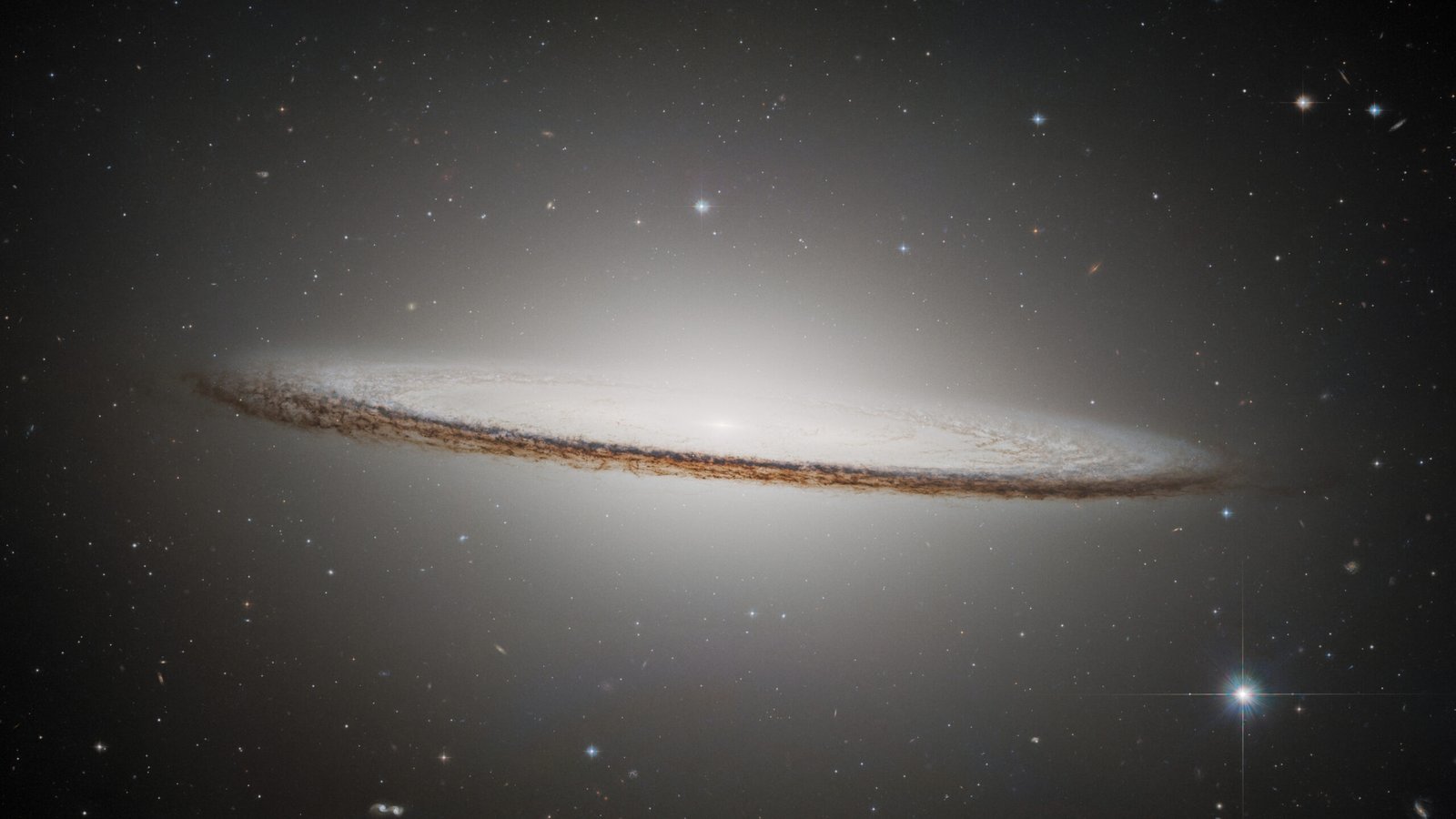
The Sombrero Galaxy earns its nickname at a glance. Seen almost edge-on from Earth, Messier 104 has a bright central bulge and a sharply defined disk that together resemble a broad-brimmed hat.
NASA places it around 30 million light-years away. Its April 2025 Hubble release explains why the familiar silhouette only tells part of the story.
The disk has characteristics associated with spiral galaxies, while the bulge and halo resemble those of elliptical galaxies. Putting those components together produces a structure that does not fit neatly into either familiar picture.
M104 also has approximately 2,000 globular clusters: dense collections of stars. That is around ten times the Milky Way figure cited in NASA’s Messier catalog.
Despite being packed with stars, the galaxy forms less than one solar mass of new stars each year, according to NASA.
The April 2025 presentation revisited existing Hubble imagery with newer processing techniques, revealing finer detail in the disk and more background objects. It did not announce the discovery of a new galaxy.
The hat-like outline makes M104 recognizable. The structure behind that outline makes it worth a closer look.